Florida Workers' Compensation Disability Benefits (2025 Guide) | Trusted for Generations
- Home
- »
- Florida Workers’ Compensation Disability Benefits

If you’ve been injured on the job in Florida, understanding your rights under the law is the first step toward recovery. Under Florida Statute 440.15, injured workers may be entitled to wage replacement benefits depending on the nature and severity of their disability. These benefits fall into two primary categories: temporary disability and permanent disability, each with its own rules, timelines, and eligibility criteria.
To help you quickly understand the different types of compensation available, we’ve included an easy-to-follow infographic summarizing the key benefit categories. For those who want to dig deeper, you’ll find comprehensive explanations below, including real case examples, definitions, and how Rosenberg & Rosenberg, P.A. can help you pursue the benefits you may be entitled to under the Florida law.
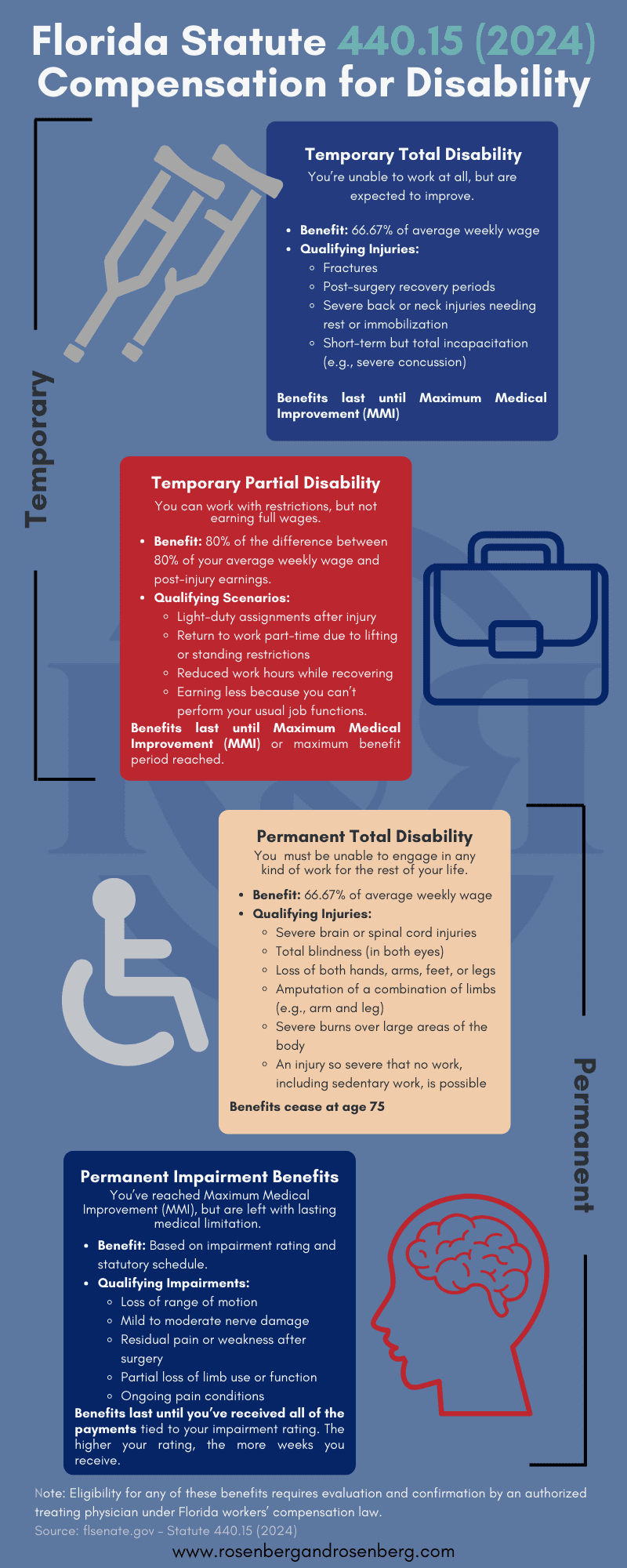
Temporary disability benefits are designed to bridge the gap while an injured worker is recovering. These benefits provide partial wage replacement before an employee reaches [Maximum Medical Improvement (MMI)], the point at which a physician determines that no significant medical improvement is expected. Understanding your rights under Florida law and working with an experienced Florida workers’ compensation attorney can help ensure you receive the full benefits you’re entitled to.
Florida recognizes two types of temporary disability
Temporary Total Disability (TTD)
Temporary Total Disability (TTD) is awarded when an injured employee is completely unable to engage in any work activity. This includes full-time, part-time, light duty, or modified responsibilities. An authorized physician must document this restriction with objective medical findings.
In some situations, such as catastrophic injuries, benefits may be extended beyond the usual cap, especially when advocated for by a skilled Florida work comp attorney.
A 42-year-old warehouse worker injured his shoulder lifting a heavy pallet. After surgery, his doctor placed him on no-work status. When his employer attempted to assign him light-duty work that didn’t match his medical restrictions, the client turned to Rosenberg & Rosenberg, P.A., a trusted Florida workers’ compensation attorney team. Our firm advocated on his behalf, and he ultimately received the Temporary Total Disability benefits he was eligible for under Florida law.
Temporary Partial Disability (TPD) benefits are available when an injured worker can return to their job, but only in a limited or medically restricted capacity. These benefits help bridge the income gap for workers who are back on the job but earning less than their pre-injury wages.
This is a critical phase in many Florida workers’ comp cases and having an experienced Florida workers compensation attorney by your side can make all the difference in maximizing your benefits and avoiding underpayment.
Even if you’re technically back to work, you may still qualify for TPD if your earnings fall below the statutory threshold. Unfortunately, many insurance carriers may interpret this gray area in ways that reduce or delay benefits.
That’s why it’s so important to work with a workers’ compensation attorney who can analyze your wage records, medical restrictions, and return-to-work details to help pursue every dollar you’re owed.
At Rosenberg & Rosenberg, P.A., our team of Florida workers’ comp lawyers has spent decades fighting for injured workers. We challenge improper TPD denials, calculate accurate wage loss, and ensure your employer’s “light duty” offer actually complies with your medical limitations.
Once a worker reaches Maximum Medical Improvement (MMI), temporary benefits end, and the focus shifts to whether any permanent loss of function remains. Florida’s workers’ compensation law provides two distinct types of permanent benefits
Permanent Total Disability (PTD) is the most significant benefit category under Florida law. It applies when an injured worker can no longer engage in any gainful employment, including sedentary, part-time, or modified positions.
To qualify, a worker must either
A 55-year-old construction worker suffered a spinal cord injury in a scaffolding fall. Despite rehab, he could not sit, stand, or concentrate for extended periods, making employment impossible. Rosenberg & Rosenberg, P.A. worked with physicians and a vocational expert to prove PTD eligibility. He now receives lifetime benefits and secured funding for future medical needs.
If an injured worker reaches MMI but still has a measurable physical or functional deficit, they may be entitled to Permanent Impairment Benefits (PIB). These are based on an impairment rating assigned by the treating physician and follow a statewide statutory schedule.
Ratings must be assigned using the Florida Impairment Rating Guide, and errors in calculations are not uncommon.
A delivery driver who fell on the job and tore her rotator cuff underwent surgery and physical therapy. She reached MMI with limited arm mobility and was assigned an 8% impairment rating. With help from Rosenberg & Rosenberg, P.A., she received her full PIB payout and later negotiated a settlement that secured future care coverage.
Impairment benefits may seem straightforward but insurance companies often assign lower ratings or miscalculate AWW. Our legal team stives to maintain accuracy throughout every stage of the process.
Maximum Medical Improvement (MMI) is one of the most important and often misunderstood milestones in a Florida workers’ compensation case. Under Florida Statute 440, MMI is defined as the stage at which your injury is no longer expected to improve substantially, even with continued medical treatment.
In other words, your healing has plateaued. While this does not mean you’re fully recovered, it does mean your condition is considered medically stable.
Once an authorized treating physician declares that you’ve reached MMI, temporary benefits stop, whether you were receiving Temporary Total Disability (TTD) or Temporary Partial Disability (TPD), those payments will end.
You may be assigned an impairment rating. This rating, based on a statewide statutory schedule, reflects the degree of permanent damage you’ve sustained.
You may become eligible for:
Your impairment rating directly affects the duration and amount of benefits you may receive going forward.
Reaching MMI is often a turning point in a claim. It not only affects your benefits but also impacts settlement discussions and your legal rights moving forward. Some employers or insurance carriers may push for an MMI determination early to cut off benefits, even if continued care is warranted.
This is where Rosenberg & Rosenberg, P.A. steps in.
With over 50 years of experience navigating Florida workers’ compensation claims, the attorneys at Rosenberg & Rosenberg, P.A. know exactly how to:
Whether your employer is pressuring your doctor or your benefits are at risk of ending too soon, we advocate so your rights are protected every step of the way.
Injured at work? You’re not just facing a medical recovery, you’re navigating a legal system that can feel overwhelming, impersonal, and stacked in favor of employers and insurance companies. That’s why choosing the right law firm matters. And for over five decades, thousands of Floridians have trusted one name to guide them through that fight: Rosenberg & Rosenberg, P.A.
We’re not just another law firm. We’re a multi-generational, family-run institution built on a legacy of advocacy, results, and personal commitment. Workers’ compensation isn’t a side practice for us, it’s a cornerstone of who we are and what we do every single day.
Founded in South Florida over 50 years ago, Rosenberg & Rosenberg, P.A. was built with one mission in mind: to serve the injured, the overworked, and the overlooked. Through the decades, our firm has remained rooted in that mission, earning a reputation for aggressive representation, compassionate counsel, and successful outcomes.
Our history isn’t just long, it’s proven. We’ve helped thousands of workers across Florida recover from life-altering injuries and receive the compensation they were legally and morally owed.
Many of our clients are second- or even third-generation referrals because when someone’s family has been helped by us, they don’t hesitate to send their loved ones to us in their time of need.
Choosing a workers’ compensation lawyer isn’t just about credentials. It’s about commitment. At Rosenberg & Rosenberg, P.A., we combine deep legal knowledge with real-world understanding of what injured workers go through physically, emotionally, and financially.
Rosenberg & Rosenberg, P.A. is not part of a corporate legal machine. We’re a family of attorneys who take pride in providing personalized service with integrity, empathy, and fierce dedication. We understand that our clients are more than case files, they’re people, families, and futures. Our founding values have passed down through multiple generations of Rosenbergs, ensuring that the quality of care and advocacy we provide is consistent, heartfelt, and principled.
We don’t dabble in a dozen practice areas. Our firm is laser-focused on injury law, especially workers’ compensation and personal injury. This means:
This focused experience allows us to go deeper, fight harder, and recover more for our clients.
With offices in the heart of South Florida, we proudly serve one of the most diverse communities in the nation. That’s why our legal team includes bilingual attorneys and staff, fluent in English, Spanish, and Creole to ensure our clients are heard and understood at every step.
Hiring a lawyer shouldn’t add to your stress. That’s why Rosenberg & Rosenberg, P.A. works on a contingency fee basis in all workers’ compensation and personal injury cases. That means:
Talk is cheap. Results matter. Over the years, our attorneys have helped recover millions of dollars in compensation for injured workers and their families. This includes:
Whether you’re just beginning the workers’ compensation process or battling through delays, denials, or unfair treatment, Rosenberg & Rosenberg, P.A. is ready to stand in your corner. We understand the stakes: your job, your income, your health, and your dignity.
That’s why we treat every case, big or small, with the urgency it deserves. To us, success means more than just a check. It means restoring peace of mind, helping families move forward, and making sure no injured worker ever has to go it alone.
Ready to Talk?
📍 Located in South Florida
🌐 Serving workers throughout Miami-Dade, Broward, Palm Beach, and beyond
📞 Call today +1 (561) 831-7245 or visit to schedule a free consultation with our team.
Your recovery is our priority. Your rights are our mission. And your trust is our legacy.
How do I calculate my Average Weekly Wage (AWW)?
It’s based on your wages from the 13 weeks prior to your injury. This figure determines most of your benefit calculations.
Can I get both TTD and TPD?
Not at the same time. However, a worker might receive TTD during recovery, then transition to TPD if returning in a modified role.
What happens after I reach MMI?
Your eligibility for temporary benefits ends, and your doctor may assign a permanent impairment rating. This rating determines your ongoing benefits.
Is hiring a lawyer necessary for workers’ comp?
You are not required to, but working with an experienced firm like Rosenberg & Rosenberg, P.A. can protect you from benefit delays, lowball offers, and wrongful denials.
Disclaimer: This content is for informational purposes only and does not constitute legal advice. For assistance with your specific case, please consult a licensed attorney.