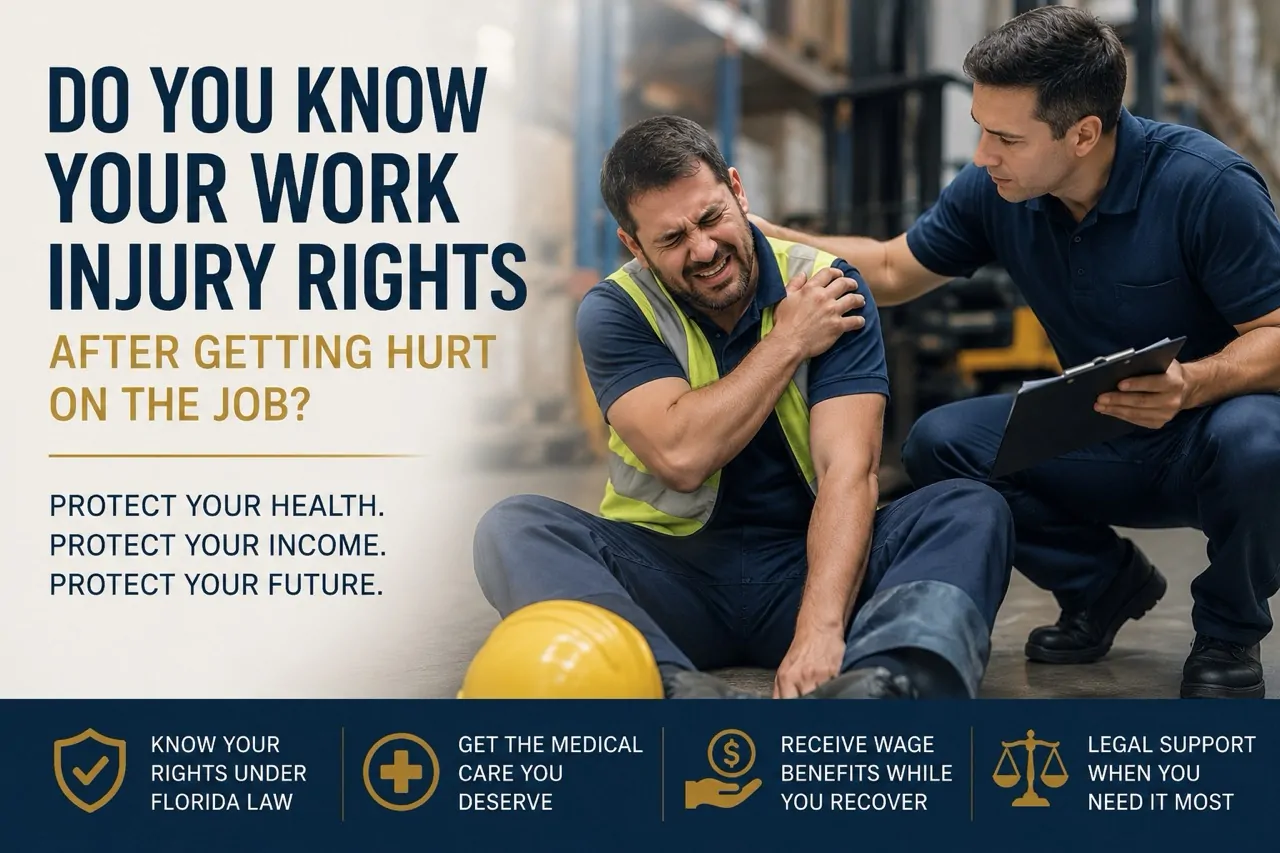
A forklift clips your shoulder in a Tampa warehouse. A wet floor sends you down hard at a Miami hotel. In seconds, everything changes. Most Florida workers do not know what to do next. Should you report it today? Who pays your medical bills? What happens to your paycheck while you heal? These questions feel overwhelming when you are already in pain.
Knowing your work injury rights early may be one of the most important steps you take after getting hurt on the job. If you are confused about what comes next after a job injury, this blog is here to help you find clarity.
What Are Your Work Injury Rights in Florida?
Florida law requires most employers to carry workers’ compensation insurance. This system provides injured workers with access to medical care and partial wage replacement after a job-related injury or illness.
You generally do not need to prove that your employer was at fault to receive these benefits. Work injury rights in Florida are designed to protect employees across most industries and job types.
Your Right to Report a Workplace Injury
Florida law gives you the right to report a work-related injury to your employer without fear of retaliation. You generally have 30 days from the date of the injury to provide notice. Reporting promptly creates an official record and helps protect your claim. Employers are prohibited from punishing workers for filing legitimate workers’ compensation reports after a job injury.
Your Right to Medical Treatment
After a work injury, you have the right to receive medical treatment covered by your employer’s workers’ compensation insurance. In Florida, your employer or their insurer typically selects the authorized treating physician.
Authorized medical care may include emergency treatment, doctor visits, diagnostic testing, surgery, and prescribed medications directly related to your work injury and recovery.
Your Right to Wage Replacement Benefits
If your injury prevents you from working or limits your ability to perform your normal job duties, you may be entitled to temporary disability benefits. These benefits replace a portion of your lost wages while you recover. The amount is calculated based on your average weekly wage. Benefits continue as long as you remain within the authorized treatment and recovery process under Florida workers’ compensation law.
Your Right to a Safe Work Environment
Florida workers have the right to a reasonably safe workplace. Employers are required to follow occupational safety standards and address known hazards. If unsafe conditions contributed to your injury, that information may be relevant to your claim.
In some cases, unsafe workplaces may also give rise to additional legal considerations beyond the standard workers’ compensation system.
What Should You Do Immediately After a Workplace Injury?
The steps you take right after a workplace injury can directly affect your ability to protect your work injury rights. Acting quickly and carefully gives your claim the strongest possible start.
Here is what you should do as soon as possible after getting hurt on the job.
- Report the injury to your employer as soon as possible — Florida law generally requires notice within 30 days; delays can create complications that are difficult to overcome later.
- Seek approved medical care — use the physician authorized by your employer’s workers’ compensation insurer to ensure your treatment is covered and properly documented.
- Document how the injury happened — write down the details of the accident while they are fresh, including the time, location, conditions, and any witnesses present.
- Keep records of all treatment and missed work — save every medical bill, prescription receipt, and note from your employer about missed shifts or modified duties.
- Avoid discussing fault without proper guidance — statements made to employers, insurers, or coworkers can be used in ways that may negatively affect your claim.
How Florida’s Workers’ Compensation System Protects Your Rights
Florida’s workers’ compensation system is a no-fault insurance program. It exists to provide injured workers with financial and medical support without requiring them to sue their employer. Most Florida employers with four or more employees are required to carry this coverage. Construction employers generally face different thresholds.
What Benefits May Be Available to You
Workers’ compensation in Florida may provide several types of support for eligible injured workers. Medical care covered by the insurer is typically the first benefit activated. If your injury limits your ability to work, partial wage replacement through temporary disability benefits may also apply.
If you require physical therapy or vocational rehabilitation to return to work, those services may also be available depending on your diagnosis and treatment plan.
What Workers’ Compensation May Not Cover
Workers’ compensation provides important protections, but it does not cover everything. Pain and suffering damages, which are available in personal injury lawsuits, are generally not recoverable through the workers’ compensation system.
Certain long-term losses, such as emotional distress or the full value of reduced career opportunities, may also fall outside the scope of what workers’ comp can address directly.
Can You Have Work Injury Rights Beyond Workers’ Compensation?
In some workplace injury cases, a party other than your employer may share responsibility for what happened. When that is the case, you may have legal options beyond the workers’ compensation system. These are called third-party claims, and they operate separately from your workers’ comp benefits.
When a Third Party May Be Responsible
A third party may be responsible when someone other than your employer or a coworker contributed to your injury. This could include a contractor, equipment manufacturer, or property owner whose negligence created unsafe conditions that led to your accident at work.
Examples of Third-Party Workplace Accidents
Common examples include injuries caused by defective machinery or tools, accidents involving a driver who was not your coworker, and injuries occurring on a property maintained by a separate company. In construction settings, subcontractors and general contractors may each have some level of responsibility depending on how the accident occurred.
How Additional Claims May Impact Your Case
Pursuing a third-party claim alongside a workers’ compensation claim can be complex. Benefits received through one channel may affect what is available through the other. Speaking with a legal professional may help you understand how these two paths interact and what pursuing both could mean for your overall recovery and compensation.
Common Mistakes That Can Affect Your Work Injury Rights
Even workers who report their injuries promptly can make mistakes that damage their claims later. Knowing what to avoid is just as important as knowing what to do.
These are some of the most common errors that may weaken your work injury rights in Florida.
- Delaying injury reporting — waiting too long to notify your employer can give insurers reason to question whether the injury happened at work, which may lead to a dispute or denial.
- Not following medical advice — gaps in treatment or ignoring doctor recommendations can be used to argue that your injuries are not as serious as claimed.
- Returning to work too early — going back before you are medically cleared can worsen your condition and may affect your eligibility for ongoing benefits.
- Giving recorded statements without guidance — insurers may use your words out of context; it is safer to understand your rights before agreeing to any recorded interview.
- Missing deadlines under Florida law — workers’ compensation has strict timelines for reporting, filing, and appealing decisions; missing them can permanently affect your ability to recover benefits.
How Fault Works in Florida Workplace Injury Cases
Florida’s workers’ compensation system does not require you to prove that your employer was at fault for your injury. You are generally entitled to benefits simply because the injury occurred during the course of your employment. This no-fault structure makes it easier for most injured workers to access medical care and wage benefits without litigation.
However, if a third party contributed to your injury, fault may become relevant in a separate civil claim. In that context, Florida’s comparative fault rules may apply, meaning that shared responsibility could affect how much compensation is available through that additional claim.
How Long Do You Have to Act on Your Work Injury Rights in Florida?
Timing is critical in Florida workplace injury cases. You generally have 30 days from the date of the injury to notify your employer. Failing to report within that window can put your entire claim at risk.
For filing a workers’ compensation petition, Florida law sets a two-year statute of limitations in most cases. This deadline begins from the date of the injury or the date benefits were last provided.
Acting early gives you more time to gather evidence, consult professionals, and build a strong record. Waiting too long can close legal doors that cannot be reopened, so understanding these timelines from the start is essential.
Speak With a Florida Work Injury Lawyer Today
Getting hurt at work is stressful enough without facing the legal process alone. Rosenberg & Rosenberg, P.A. has been helping injured workers across South Florida for over 50 years. We understand how much is at stake when your health and income are on the line.
Our team is available 24 hours a day, 7 days a week. We offer free consultations, and attorney’s fees are contingent upon recovery, with court costs and case expenses also considered at resolution.
Speaking with our team may help you understand your work injury rights and what options may be available to you. Let our family help your family.
Disclaimer: The information provided in this article is for general informational purposes only and should not be taken as legal advice. Viewing this content does not create an attorney-client relationship with Rosenberg & Rosenberg, P.A. Every case is different, and results depend on the specific facts and circumstances involved. You should consult a qualified attorney regarding your specific situation. Rosenberg & Rosenberg, P.A. serves clients in Hollywood, Fort Lauderdale, and surrounding communities throughout South Florida.